Choosing the right visual editing tools is a pivotal decision that can either elevate your work or hinder your creative flow. Whether you are a professional photographer or a budding illustrator, high-quality software provides the technical foundation needed to manifest your vision. Investing in these tools is not just about features; it’s about empowering your artistic heart to achieve greatness.
Knowing Visual Editing Tools
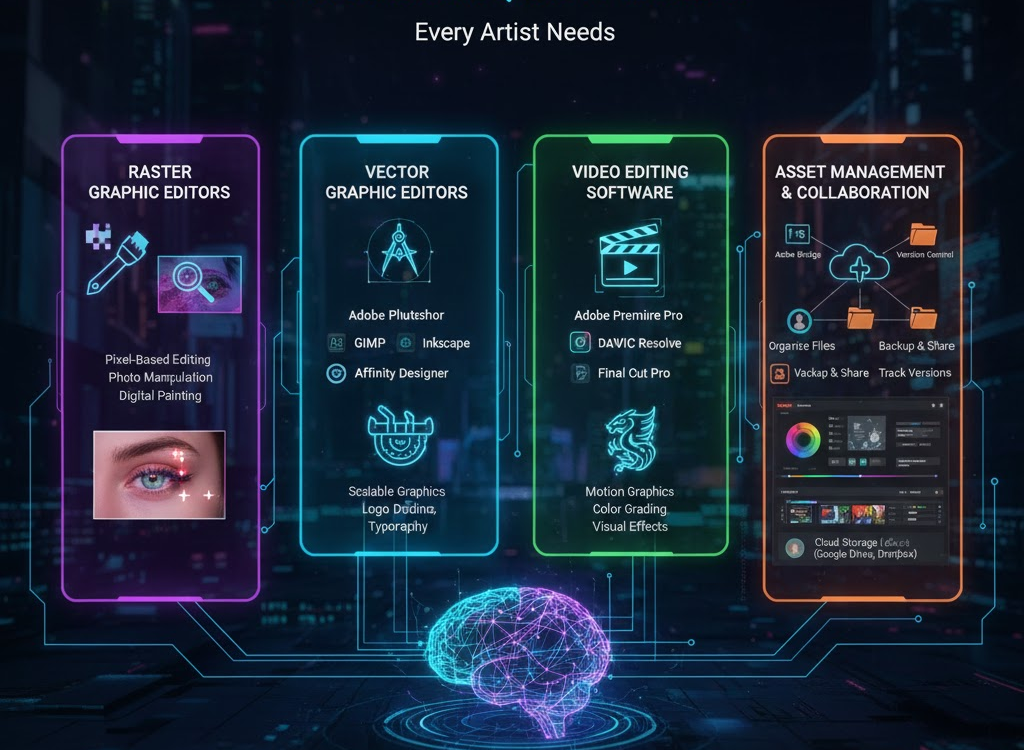
Visual editing tools are a wide term that is used to describe a wide range of computer programs that can assist in manipulating and creating visual imagery. These devices include very basic picture editing software to software with high features in graphics design. The need to produce high quality images is ever increasing hence the significance of the correct tools in producing quality images which can only be attributed to professionalism.
Why Quality Tools Matter
Tools can greatly influence your end result by the quality of the tools you employ. Leading industry software is usually used by professional artists to make sure that the work they produce is of the best standards. As an example, Adobe Photoshop and Illustrator have gained the reputation of quality in art. The tools are not only able to add value to the final product, but also optimize your workflow, enabling you to be creative instead of solving technical issues.
The most important Visual Editing Devices as an artist
1. Adobe Photoshop
Adobe Photoshop is probably the best known visual editing tool in the industry. It has a wide range of features, which enable artists to edit photos, retouch images, and produce beautiful pieces of digital art. The ability to add layers, filters and a vast array of brushes, Photoshop gives the artist the freedom to explore and make his or her visions come true.
Real-World Instance: Famed photographer Annie Leibovitz uses Photoshop to make her portraits of the famous just right. The program lets her control the light, colors, and even to retouch small blemishes so that her photographs are perfected before they hit the eyes of the masses.
2. Adobe Illustrator
Adobe Illustrator is a very crucial tool to artists who specialize in vector graphics. In contrast to raster images, vector graphics are not dependent on the resolution, i.e. any size can be scaled without damaging the graphic. Illustrator is a popular tool among graphic designers because it is popular in the production of logos, illustrations and typography.
Expert Advice: Chris Do, one of the leading graphic designers and educators, highlights the necessity of learning the Insight of using Illustrator in graphic designing. He observes that knowledge of the vector graphics is crucial to creating quality work which is distinguishable.
3. CorelDRAW
CorelDRAW is yet another robust tool of graphic design in the form of the vectors which has provided a user friendly interface with numerous design capabilities. Artists, especially those who do print and layouts, are finding it very popular. CorelDRAW has powerful typography, color control and numerous templates which make the process of designing an image easier.
4. Procreate
To digital artists, Procreate has changed the manner at which art is created on the go. This app in iPad enables artists to draw and paint in a natural way as in conventional media. Procreate is perfect in sketching, illustrating, and finishing artwork because of its intuitive interface, a great range of brushes, and tools.
Real Life: Procreate is very portable and efficient that many illustrators and concept artists use it to create their sketches and final work, even when traveling or at conventions.
5. Canva
Canva has become a popular graphic design tool due to its versatility and may be used by people having no or limited design knowledge. It has a drag and drop interface, enabling users to make beautiful visuals in a short time, which makes it more perfect in creating social media graphics, presentations, and marketing content. Canva is not as useful as Photoshop or Illustrator, but it can be used to create visually pleasing content with minimum effort.
6. GIMP
Gimp (GNU Image Manipulation Program) is a great option to Adobe Photoshop in case people want a free variant of this program. Gimp is a versatile software that can be used to do photo retouching, image composing, and more advanced editing. GIMP is open-source and is constantly improved by a group of developers, which makes it a competitive solution in the market.
7. Affinity Photo
The Affinity Photo has become a serious challenger of Adobe Photoshop, with its variety of professional facilities and a lower cost. It has state of the art image editing, such as HDR combining, focus grouping and sharp selection instruments. Affinity Photo has become a favorite of many photographers and digital artists because of its powerful functionality without the subscription model.
Selecting the Tool to Your Requirement
To choose the appropriate visual editing tools to your artistic activity, one should be careful. The following are some of the factors to be considered:
Type of Project: Evaluate the type of projects. Do you work mostly with photo editing, graphic design, or digital painting? The various instruments suit different artistic requirements and style.
Budget: There are quite a few free and inexpensive tools that can satisfy your needs and do not force your wallet. Minimize your budget and check out some alternatives such as GIMP, Canva and Affinity Photo.
Learning Curve: How familiar are you with learning new software? The learning curve of some of these tools is higher than others and time spent in tutorials, or online courses, can therefore be helpful.
Visual editing tools are used in real-life scenarios
To provide the examples of the effects of these tools, we can take a look at some examples:
Photographer: This career path may begin with a basic editing software to augment the photos. Later on as they become more proficient, they can switch to Adobe Lightroom and do corrections that are more advanced, and then switch to Photoshop and perform a more detailed correction. This development presents the applications of various tools in different phases of an artist.
Workflow of the Graphic Designer: A graphic designer may make a logo using Illustrator and then use the logo in Canva to do promotional materials. In such a cross-utilization of tools, it is pointed out how they can be used in order to complement one another, thus increasing productivity and creativity.
Conclusion
High-quality visual editing tools are vital in the production of work that is of professional quality by artists. Since Adobe Photoshop and Illustrator, they have had a variety of functions that serve to fulfil various artistic requirements in the form of Procreate and Gimp. Knowing what you need and deciding what you can do will help you in the creative process and make your art on a higher level.
When starting your artistic career, you should keep in mind that using the correct tools can enable you to realize your potential creativity and produce beautiful works that will appeal to the audience.
FAQs
1. What do we mean by visual editing tools?
Visual editing tools refer to computer programs that are used to alter, amplify and produce visual works, which are very much needed by artists in different professions.
2. Do we have any free alternatives to Adobe Photoshop?
Yes, Gimp and affinity photo are also great free alternatives which have most of its features without the price.
3. What should I do to find the appropriate editing tool for my art?
To identify the best tool that fits your requirements, think of what type of project you are engaged in, your budget, and how comfortable you are with the new software.